
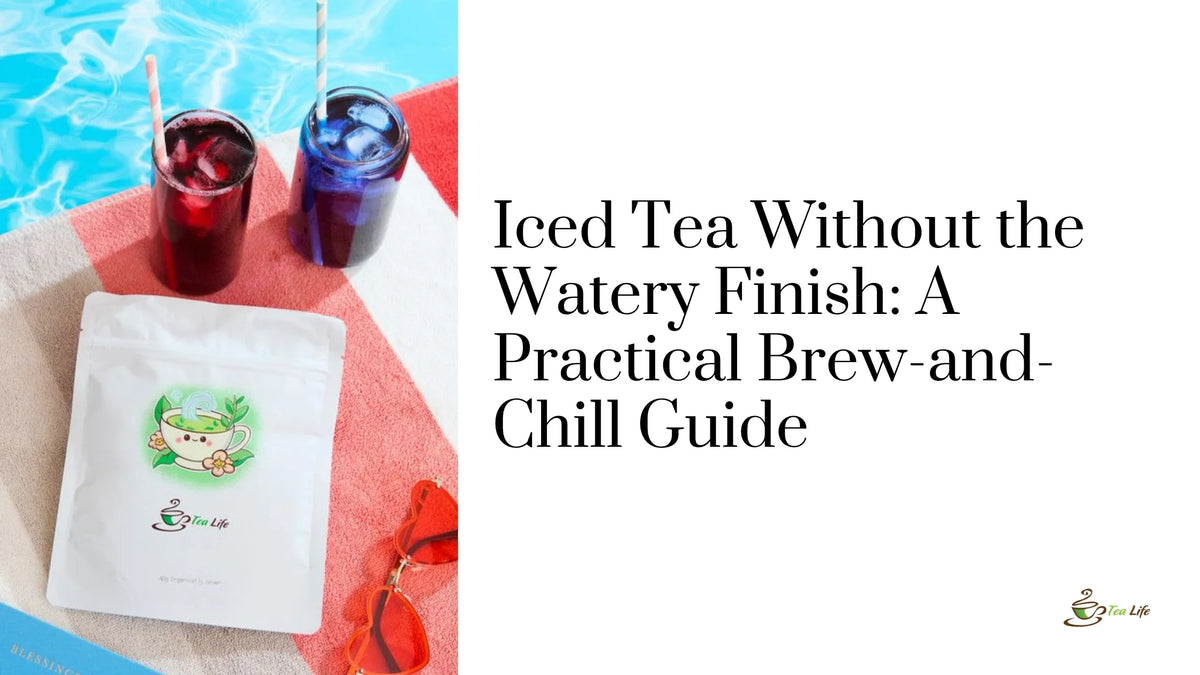
There’s nothing wrong with a glass of iced tea on a warm afternoon. The problem is when the first few sips taste great, but the rest become weak and watery as the ice melts.
The fix usually starts before the ice goes anywhere near your glass. The amount of tea you use, the brewing time, the water temperature and the way you chill the finished drink all affect the result.
The good news is that you don’t need complicated equipment or a long list of ingredients. With a kitchen scale, a jug and a little planning, you can make loose-leaf iced tea that keeps its flavour from the first sip to the last.
Why does iced tea taste watery?
When ice melts, it adds water to your drink. If your tea is already quite weak, that extra water can make the flavour disappear quickly.
The simplest solution is to account for the ice when you prepare your tea. Rather than brewing a normal-strength cup and pouring it over a handful of ice, start with a stronger infusion or use a cold-brewing ratio suited to the tea.
There are three things worth considering:
-
Tea quantity: More tea relative to the water generally produces a stronger infusion.
-
Brewing time: Too little time can leave the flavour underdeveloped, while excessive steeping may make some teas harsh or overly intense.
-
Ice and final volume: The amount of ice you add affects how much the drink dilutes as it chills.
Different teas need different approaches. A fruit infusion, hibiscus and rooibos each have their own flavour profile, so the same measurements will not necessarily suit all three.
Hot brew or cold brew: which works better?
Both methods can make excellent iced tea. The best choice depends on how much time you have and the flavour you want.
Hot brew, then chill
This is a practical option when you want iced tea the same day. You brew the tea using hot water, strain out the leaves or botanicals, and cool the infusion before serving.
For iced tea, some products recommend brewing at double strength and pouring the infusion over ice. This helps compensate for the dilution that follows. Always check the individual product instructions because the recommended temperature and steeping time can vary.
For example, our brewing instructions for Orange Summer Fruit Tea recommend using 8 to 10 grams in 500 ml of hot water, steeping for 8 to 10 minutes, and straining over ice.
The advantage is speed. The main thing to watch is how much ice you use. A large quantity can still weaken the finished drink if the original brew is not concentrated enough.
Cold brew in the fridge
Cold brewing uses cool water and a longer steeping time. It can be useful when you want to prepare a jug ahead of time, particularly with suitable fruit infusions and botanicals.
The flavour can differ from a hot-brewed version. Some ingredients taste softer when steeped in cold water, while others may take longer to develop their full character.
Do not assume that every tea or botanical is suitable for overnight cold brewing. Follow the specific product instructions and use a suitable preparation method for the ingredients you have chosen.
For a simple starting point, our Hibiscus Tea product instructions recommend 5 to 8 grams per litre of cold filtered water, refrigerated for 6 to 8 hours before straining.

Three iced teas to try
Fruit infusions, hibiscus and rooibos offer three different ways to approach iced tea. The following recipes provide starting measurements for testing at home. The tasting descriptions are flavour expectations based on the ingredients, not results from a controlled comparison.
|
Tea |
Starting recipe |
Ice and serving |
Expected flavour |
|
8 to 10 g in 500 ml hot water, at 95 to 100°C, for 8 to 10 minutes |
Strain over a measured amount of ice and record the final volume |
Citrus, fruit and a gentle tartness |
|
|
5 to 8 g per litre of cold filtered water, refrigerated for 6 to 8 hours |
Strain, measure the yield and serve over ice |
Tart, cranberry-like and lightly floral |
|
|
Start with the product's hot-brewing guidance of at least 5 minutes, then chill before serving |
Add measured ice and adjust the initial strength if needed |
Smooth, rounded and naturally mellow |
For a fair comparison, weigh each tea rather than relying on teaspoons. Loose-leaf ingredients vary in size and density, so a spoonful of one blend may weigh considerably more than a spoonful of another.
Record the water volume, steeping time, temperature where applicable, ice weight and final drink volume. Taste each preparation before adding sweetener. This makes it easier to identify whether a weak result comes from the original brew or from dilution.
How much ice should you use?
There is no single ice measurement that suits every jug or glass. What matters is the amount of water the melting ice adds to your tea.
If you brew 500 ml of tea and pour it over 200 grams of ice, some of that ice will melt immediately as the hot liquid cools. The final amount of drink will depend on how much ice melts and how much remains.
For a more consistent result, weigh the ice and record the final volume after chilling. You can then repeat the recipe with slightly less ice or a stronger brew to see which gives you the flavour you prefer.
For a jug that will sit on the table, chill the tea before serving and add ice to individual glasses. This helps keep the main batch from becoming diluted as everyone pours a drink.
If you prefer to chill the entire jug with ice, make the initial infusion stronger and account for the extra water it will receive.
How to avoid bitter or overly sharp iced tea
A strong brew does not have to taste harsh. If your iced tea is bitter, astringent or too tart, changing the tea-to-water ratio is not always the answer.
Start by checking the brewing instructions. Tea leaves and botanicals respond differently to heat and steeping time. Some green teas, for example, need cooler water than robust herbal infusions.
For fruit infusions, allow enough time for the fruit and botanicals to develop their flavour. Hibiscus is naturally tart, so a shorter steep may produce a lighter result, while a longer one can give a more pronounced flavour. Rooibos has a different profile, with a naturally mellow taste that can work well when chilled.
If the finished drink is too intense, dilute it with a small amount of cold water and note the change. If it is too weak, increase the tea quantity slightly next time rather than automatically extending the steeping time.
You can also add lemon, fresh mint or sliced fruit if they suit the blend. Make one change at a time so you can work out what improves the flavour.
Should you sweeten iced tea?
That comes down to personal preference. Try the tea without sweetener first, especially if you are using a fruit infusion with naturally fruity notes.
If you prefer a sweeter drink, add a small amount of sugar, honey or your preferred sweetener while the tea is still warm, when it will dissolve more easily. For cold-brewed tea, stir thoroughly and taste before adding more.
You can also use fresh fruit for extra flavour, but remember that adding fruit does not automatically make a drink sugar-free. Fruit contains naturally occurring sugars, and any added sweetener should be accounted for separately.
How should you store homemade iced tea?
Prepare iced tea using clean equipment and suitable drinking water. Once the tea has been brewed and strained, cool it promptly and refrigerate it in a clean, covered container.
Avoid leaving a jug sitting at room temperature for extended periods, particularly in warm weather. Follow applicable food-safety guidance for preparation and storage, and discard tea if you are unsure whether it has been stored safely.
Do not assume that every tea has the same safe storage life. Ingredients, handling and storage conditions can vary, so avoid preparing more than you can reasonably use before the recommended storage period.
Make your next glass count
Good iced tea is mostly about getting the proportions right. Start with the brewing instructions for your chosen tea, account for the ice, and chill the finished infusion before serving whenever possible.
Fruit blends are a good place to experiment with bright, refreshing flavours. Hibiscus offers a naturally tart option, while rooibos gives you a smoother alternative. Once you find a ratio you enjoy, write it down so you can repeat it.
Explore the Iced Tea collection to find a blend for your next jug, and check the individual product pages for brewing guidance. A few measured adjustments can make the difference between a drink that fades as the ice melts and one that stays enjoyable to the last sip.
Share:
The Myrtle Edit: Save 15% on Selected Myrtle Teas
Buying Fruit and Iced Teas in New Zealand: A Spring Selection Guide